
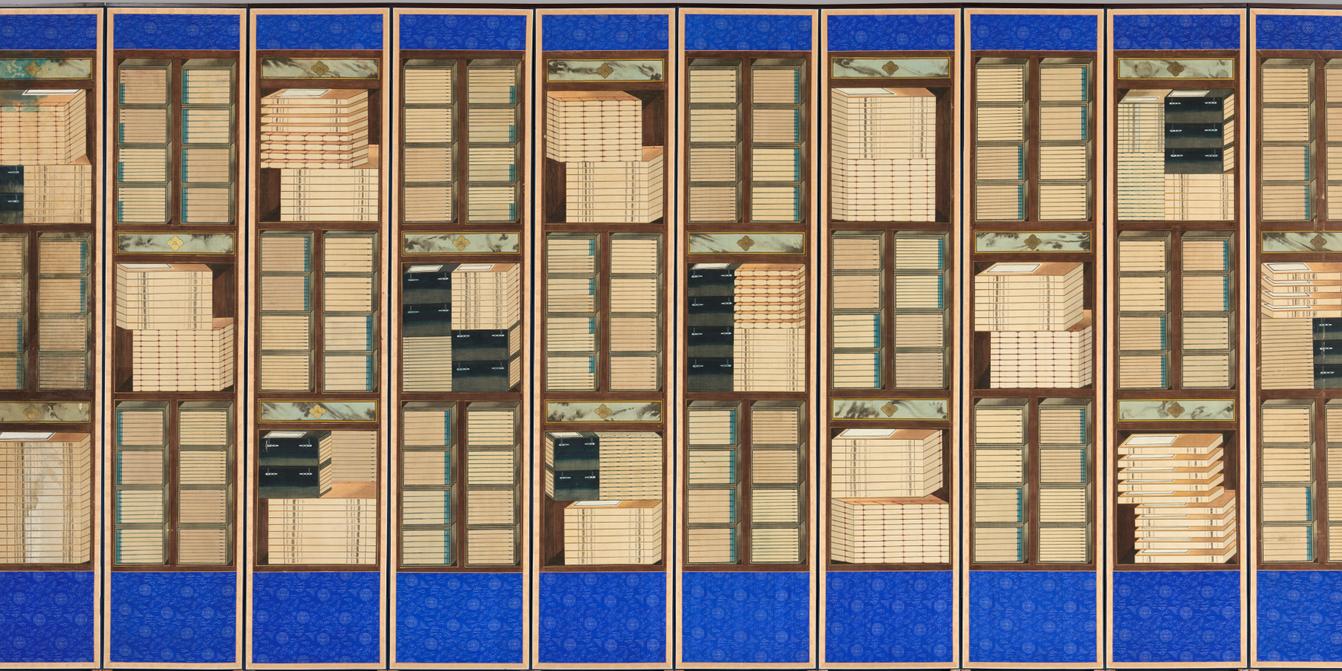
In late 18th-century Korea, during the golden age of the Joseon period (1392-1910), King Jeongjo (1752-1800), an avid reader, devised a way to always be surrounded by books. He commissioned the kingdom's painters to create folding screens depicting the contents of his library, which would be displayed behind him. Beyond the pleasure he took in being constantly immersed in a literary environment, he wanted to show his visitors what an intellectual he was and how much importance he gave to the written word. In a less self-centered way, he also wished to encourage his subjects to read and elevate themselves.
This initiative was soon imitated throughout the kingdom, giving rise to a pictorial genre known as chaekgeori. This art of trompe-l'œil (which means "deceive the eye") folding screens adorned with books – and later, decorative objects – flourished from the 18th to the 20th century, spreading beyond aristocratic circles and evolving over the decades.
The Guimet Museum of Asian Arts in Paris is dedicating an exhibition to this uniquely Korean movement, completing a trilogy of events organized to celebrate the 140th anniversary of Franco-Korean diplomatic relations. The program began in March with an exploration of K-beauty and continued in June with a focus on the Silla kingdom.
General
At the Guimet Museum in Paris, the Korean art of trompe-l'œil libraries
Source
Le Monde
· Sylvie Kerviel